

Most organizations treat cognitive accessibility as a compliance checkbox. They run automated scans, fix contrast ratios, add alt text, and call it done. But the companies pulling ahead in competitive markets right now are the ones that recognized something different: cognitive accessibility is not a cost center. It is a strategic asset that drives customer acquisition, retention, and brand loyalty in ways traditional marketing cannot replicate.

- Cognitive accessibility innovations create measurable competitive advantages through broader market reach, higher customer satisfaction, and reduced legal exposure.
- Organizations that embed cognitive accessibility into product strategy outperform competitors who treat it as an afterthought.
- The shift from compliance-only to strategic accessibility separates market leaders from the rest.
That number represents lost revenue, not just a compliance gap. Every visitor who abandons a confusing checkout flow or gives up on a dense registration form is a customer your competitor can capture by simply being clearer.
How Cognitive Accessibility Creates Competitive Advantages
Cognitive accessibility creates competitive advantages through three distinct mechanisms: market expansion, differentiation, and risk reduction.
Market expansion is the most direct benefit. Roughly 15-20% of the global population has some form of cognitive difference or disability. Add situational impairments (stress, fatigue, multitasking, unfamiliar language) and the addressable audience grows significantly. A banking portal that simplifies its loan application process does not just help users with dyslexia. It helps every customer filling out forms on a phone while commuting.
Differentiation works because most competitors stop at technical WCAG compliance. They check color contrast, keyboard navigation, and screen reader compatibility. Cognitive accessibility goes further:
- Simplified language and clear information hierarchy
- Predictable navigation patterns that reduce cognitive load
- Error prevention and recovery that does not punish mistakes
- Content chunking that matches working memory limits
- Consistent terminology across the entire user journey
Risk reduction is the third lever. The European Accessibility Act (EAA) enforcement timeline is tightening. ADA litigation in the United States continues to rise. Organizations that proactively address cognitive accessibility build a defensible compliance posture that reduces legal exposure and audit costs.
Businesses Gaining an Edge Through Accessibility

Real organizations have turned cognitive accessibility into measurable market advantages. These are not hypothetical scenarios.
Microsoft redesigned its Office 365 onboarding flows with cognitive accessibility principles: progressive disclosure, plain language tooltips, and simplified decision trees. The result was higher activation rates across all user segments, not just users with disabilities. The improvements benefited enterprise customers onboarding non-technical staff, education institutions with diverse student populations, and government agencies with strict accessibility mandates.
Barclays invested in cognitive accessibility for its online banking platform. They simplified transaction confirmations, added clear progress indicators for multi-step processes, and reduced jargon in account management screens. Customer support call volume dropped. Satisfaction scores increased. The bank positioned itself as the accessible choice in a crowded UK banking market.
Gov.uk (the UK Government Digital Service) built its entire design system around cognitive accessibility. Plain language. Short sentences. One idea per paragraph. Predictable layouts. The result: task completion rates that consistently outperform private sector equivalents. Other governments now reference Gov.uk as the standard.
Target settled an accessibility lawsuit in 2008 for $6 million and then invested heavily in accessible design. The company went from defendant to industry leader, using accessibility as a brand differentiator in retail e-commerce.
These examples share a pattern: the initial investment in cognitive accessibility produced returns that extended far beyond the disability community. Clearer interfaces convert better for everyone.
Leveraging Accessibility as a Differentiator

Turning cognitive accessibility into a genuine differentiator requires more than adding it to a marketing slide. It demands integration into product strategy, procurement criteria, and organizational culture.
Here is the process that separates leaders from followers:
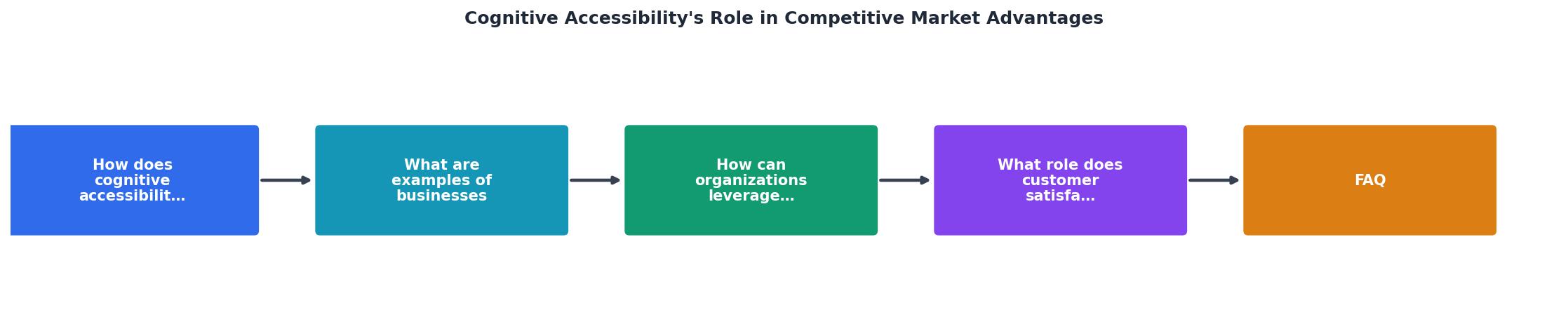
The steps break down as follows:
- Audit your current digital properties for cognitive barriers, not just WCAG technical violations. Tools like PagePerson Insights can surface comprehension issues that standard automated scanners miss entirely.
- Benchmark against competitors. How does your cognitive load compare to the top three alternatives in your market? If your competitor's checkout flow takes five decisions and yours takes twelve, you lose.
- Prioritize fixes by business impact. Start with high-traffic, high-value pages: landing pages, pricing pages, signup flows, and checkout processes.
- Implement changes using evidence-based cognitive accessibility patterns: plain language, progressive disclosure, consistent navigation, and clear error handling.
- Measure the impact on conversion rates, task completion, support tickets, and customer satisfaction scores.
- Document everything for compliance records and stakeholder reporting.
"Most importantly, accessibility should be seen as a long-term commitment rather than a one-time project.">, Why digital Accessibility Matters: Benefits for Users & Businesses
This is not a one-quarter initiative. Organizations that treat cognitive accessibility as a continuous improvement cycle maintain their competitive edge. Those that treat it as a project with an end date fall behind as standards evolve and competitors catch up.
Customer Satisfaction Drives Market Position
Customer satisfaction is the mechanism that converts accessibility investment into sustained competitive advantage. The logic is direct: cognitively accessible experiences reduce frustration, frustration reduction increases satisfaction, and satisfied customers stay longer, spend more, and refer others.
Consider the healthcare sector. Patient portals with clear language, simple navigation, and predictable layouts see higher engagement rates. Patients who can actually understand their test results, medication instructions, and appointment scheduling are more likely to stay with that provider. In a market where patient acquisition costs are rising, retention through better experience is a strategic advantage.
The same applies to financial services, education platforms, government digital services, and e-commerce. Every sector where users must comprehend information to complete a task benefits from cognitive accessibility.
That number should concern any organization competing on digital experience. Two-thirds of customers will leave. Not because your product is worse, but because your interface is harder to understand.
The following dashboard illustrates how cognitive accessibility metrics map to competitive positioning across key dimensions:
Competitive Impact: With vs. Without Cognitive Accessibility
These metrics are interconnected. Higher task completion reduces support costs. Lower legal risk exposure frees budget for further innovation. Customer retention compounds over time.
| Compliance-Only Approach | Strategic Accessibility Approach |
|---|---|
| Fixes WCAG technical violations | Addresses cognitive comprehension barriers |
| Reactive (responds to audits/lawsuits) | Proactive (continuous improvement cycle) |
| Minimal impact on conversion | Measurable conversion and retention gains |
| Viewed as a cost center | Treated as a revenue driver |
| Covers visual and motor accessibility | Includes cognitive load, language clarity, decision support |
| One-time project mindset | Long-term organizational commitment |
Cognitive Accessibility Competitive Strategy Checklist
Your progress is saved automatically in your browser.
FAQ
Frequently Asked Questions
Additional Resources
- Why digital Accessibility Matters: Benefits for Users & ... - In reality, accessibility is a competitive advantage. ... Neurodiversity and cognitive accessibility play a crucial role in improving digital experiences.
- Accessibility, competitiveness and performance relationships - The importance of accessible tourism as a source of innovation and competitive advantage is growing in today's dynamic environment (Milovanovic, 2023).
- Digital Accessibility in the Workplace: From Compliance to ... - Digital accessibility is shifting from a compliance requirement to a key driver of inclusion, productivity, and innovation in the modern ...