
Most companies treat cognitive accessibility as a checkbox buried inside a larger compliance spreadsheet. That is a mistake with a price tag. Organizations that invest in making their digital products understandable to people with ADHD, dyslexia, anxiety, and low digital literacy consistently report fewer lawsuits, broader market reach, and measurable revenue growth. This article breaks down exactly how cognitive accessibility compliance connects to the bottom line and what you can do about it today.

- Cognitive accessibility compliance reduces legal exposure under the ADA, Section 508, and the European Accessibility Act while simultaneously improving user experience for all visitors.
- Companies that go beyond visual/technical WCAG checks and address cognitive barriers see increased conversion rates, expanded market reach, and stronger customer retention.
- The revenue impact is not theoretical: organizations report double-digit improvements in task completion and engagement after cognitive accessibility remediation.
The compliance landscape right now
Accessibility compliance used to mean alt text, color contrast, and keyboard navigation. Those still matter. But regulators and courts have expanded their scope. The European Accessibility Act (EAA), enforceable from June 2025, explicitly covers digital products and services across the EU. The Americans with Disabilities Act (ADA) continues to generate thousands of web accessibility lawsuits per year in the United States. Section 508 governs federal agencies and their contractors. EN 301 549 sets the technical standard in Europe.
What changed recently is the growing recognition that cognitive accessibility sits at the center of genuine compliance. WCAG 2.2 introduced success criteria directly targeting cognitive load, and the W3C's Cognitive and Learning Disabilities Accessibility Task Force has been pushing for even more explicit requirements. If your compliance program ignores cognitive barriers, it has a gap that regulators and plaintiffs can exploit.
That number keeps climbing. Cognitive accessibility claims are a growing subset because they affect the largest group of people with disabilities worldwide.
How compliance cuts legal risk

Legal risk from accessibility failures is not abstract. Settlement costs in ADA web accessibility cases routinely reach six figures. Repeat offenders face injunctions, ongoing monitoring requirements, and reputational damage that erodes customer trust.
Cognitive accessibility compliance reduces legal risk in three concrete ways:
- Documented due diligence. Courts and regulators look for evidence that an organization took reasonable steps. A cognitive accessibility audit trail, including reports on reading level, navigation complexity, and form comprehension, demonstrates proactive effort.
- Broader coverage. Traditional accessibility tools catch about 30% of WCAG issues automatically. Cognitive barriers like confusing instructions, ambiguous button labels, and overwhelming information density require human-informed analysis. Covering these gaps closes the door on claims that your compliance program was superficial.
- Reduced complaint volume. When users with cognitive disabilities can actually complete tasks on your site, they do not file complaints. This sounds obvious, but many organizations only discover their cognitive accessibility gaps after receiving a demand letter.
"Your accessibility audit shows you're 87 percent compliant.">, Beyond Compliance: Accessibility Outcomes by Audience
That remaining 13% often lives in the cognitive layer. And 87% compliant is not compliant. It is 13% exposed.
The gap between 87% and full compliance is where cognitive accessibility lives, and where lawsuits originate.
Revenue impact of accessibility

Compliance is a cost center until you realize what it unlocks. The revenue impact of cognitive accessibility compliance operates through several channels:
Conversion rate improvements. Simplifying form instructions, reducing cognitive load on checkout pages, and clarifying calls to action directly increases the percentage of visitors who complete a purchase or signup. These are not accessibility-specific gains. Every visitor benefits from clearer interfaces. But the improvements are most dramatic for the estimated 15-20% of the population with some form of cognitive disability or situational cognitive impairment (stress, fatigue, multitasking, unfamiliar language).
Reduced support costs. Confusing interfaces generate support tickets. Every call or chat session costs money. Organizations that remediate cognitive barriers on their self-service portals consistently see support volume drop.
SEO and discoverability. Clear headings, logical page structure, plain language, and descriptive link text are cognitive accessibility requirements. They are also exactly what search engines reward. Compliance work and SEO work overlap significantly.
That is one in five visitors. Losing even a fraction of them to confusing interfaces adds up fast.
The following dashboard illustrates how a typical mid-size e-commerce company might see these revenue channels shift after a cognitive accessibility remediation project:
Revenue Metrics: Before vs. After Cognitive Remediation
These figures represent a composite scenario based on common patterns reported by e-commerce companies after cognitive accessibility projects. Your specific numbers will vary, but the direction is consistent.
Expanding market reach
Cognitive accessibility compliance opens doors to customer segments that competitors ignore. Consider these groups:
- Older adults. People over 65 are the fastest-growing internet user demographic. Age-related cognitive changes (slower processing speed, reduced working memory) mean they benefit enormously from cognitively accessible design.
- Non-native speakers. Plain language, clear navigation, and predictable layouts help users who read your site in their second or third language.
- People in high-stress contexts. Healthcare patients reading test results, insurance customers filing claims, banking users managing finances during a crisis. Cognitive load is situational, not just clinical.
- Users with low digital literacy. Globally, digital literacy varies wildly. A site that only works for tech-savvy users leaves money on the table.
Compliance is the entry ticket. The revenue follows.
Case studies worth studying

Microsoft invested heavily in inclusive design principles, including cognitive accessibility, across its product suite. The result was not just compliance but a competitive advantage: products like Microsoft Teams and Office 365 gained adoption in education and government sectors where accessibility is a procurement requirement.
Barclays rebuilt its online banking platform with cognitive accessibility as a core design constraint. Simplified navigation, clearer transaction descriptions, and reduced form complexity led to measurable increases in digital banking adoption among older customers, a demographic that generates significant deposit and investment revenue.
Target settled an ADA web accessibility lawsuit for $6 million in 2008. The company then invested in comprehensive accessibility, including cognitive elements. The long-term result was a more usable site for all customers and elimination of ongoing legal costs.
Gov.uk rewrote its entire digital presence using plain language and cognitive accessibility principles. Task completion rates jumped significantly, reducing the volume of phone calls to government offices and saving millions in operational costs annually.
These are not charity projects. Each one generated measurable financial returns.
How compliance builds loyalty
Customers notice when a site respects their time and cognitive capacity. They may not use the word "accessibility," but they feel the difference between a frustrating experience and a smooth one.
Loyalty mechanics tied to cognitive accessibility:
- Reduced friction creates habit. When a task is easy to complete, users come back. When it is confusing, they find an alternative. Cognitive accessibility directly reduces the friction that drives churn.
- Trust through transparency. Clear language, predictable navigation, and honest error messages build trust. Trust drives repeat purchases and referrals.
- Inclusive brand perception. Younger consumers increasingly factor social responsibility into purchasing decisions. Demonstrable accessibility commitment strengthens brand perception.
Tools like PagePerson Insights can help you identify cognitive barriers across your site, giving you both the compliance documentation you need and the UX insights that drive revenue improvements.
The compliance-to-revenue process
This diagram shows how cognitive accessibility compliance flows from audit through remediation to measurable revenue outcomes:
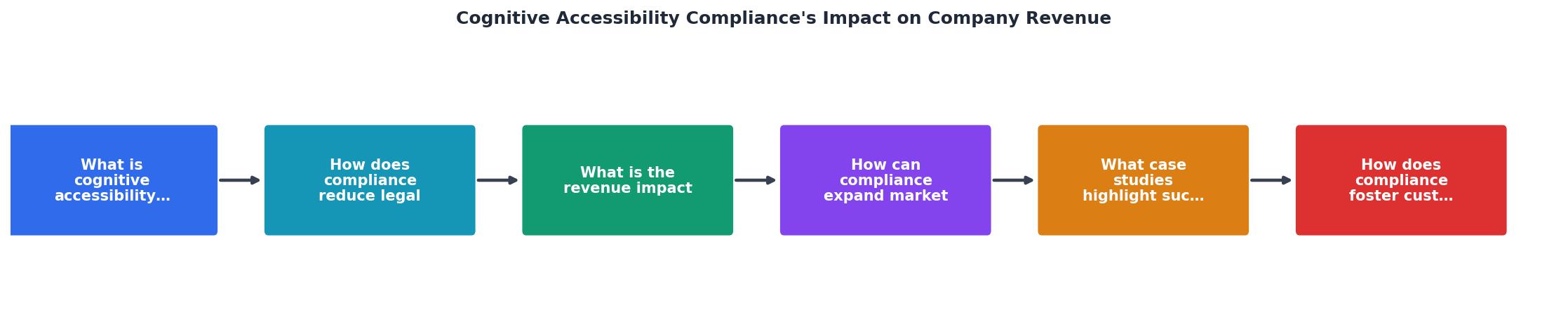
The process follows five stages: Audit existing pages for cognitive barriers, Prioritize issues by revenue impact and legal risk, Remediate with clear language and simplified flows, Document changes for compliance records, and Measure the revenue and engagement impact. Each stage feeds back into the next cycle.
| Without Cognitive Compliance | With Cognitive Compliance |
|---|---|
| Legal exposure to ADA/EAA claims | Documented due diligence |
| 13%+ of barriers undetected | Full-spectrum coverage |
| Higher bounce rates on complex pages | Improved task completion |
| Excluded older adults and non-native speakers | Expanded addressable market |
| Reactive support costs | Reduced ticket volume |
| Generic brand perception | Inclusive brand advantage |
Cognitive Accessibility Compliance Checklist
Your progress is saved automatically in your browser.
FAQ
Frequently Asked Questions
What cognitive accessibility barriers have you found on your own site, and how did addressing them change your metrics? Share your experience below.
Additional Resources
- Beyond Compliance: Accessibility Outcomes by Audience - But accessibility gaps directly impact your marketing outcomes: They shrink your addressable market, hurt campaign performance, damage brand ...
- The Economic Case for Digital Accessibility - Top technology companies have also demonstrated that designing for digital accessibility can drive higher revenues and broader market reach, a lesson that ...
- Why digital Accessibility Matters: Benefits for Users & ... - Beyond direct sales, accessibility strengthens a brand's reputation. Companies that embrace inclusivity foster customer loyalty and build trust, showing they ...