

Most organizations treat cognitive accessibility as a compliance checkbox. They meet the minimum WCAG criteria, file the audit report, and move on. But the companies pulling ahead in competitive markets are doing something different. They treat cognitive accessibility as a product strategy, and the results show up in user retention, brand trust, and market share growth.

- Cognitive accessibility innovations go beyond compliance to create genuine product differentiation.
- Accessible products build measurable user trust, expand addressable audiences, and reduce churn.
- Organizations that invest in cognitive accessibility early gain defensible market advantages that competitors struggle to replicate.
Cognitive Accessibility as Differentiation
Most digital products in any given category look and function similarly. Same layout patterns, same checkout flows, same onboarding sequences. Cognitive accessibility breaks that sameness.
When a banking app simplifies its mortgage calculator so a first-time buyer with no financial background can complete it without confusion, that app stands apart. When a healthcare portal presents test results in plain language with clear next steps instead of dense medical jargon, patients remember it. These are not cosmetic changes. They are structural product decisions that reshape how users perceive a brand.
Product differentiation through cognitive accessibility works because it addresses a gap most competitors ignore. Standard accessibility audits catch missing alt text, insufficient color contrast, and keyboard navigation issues. Cognitive barriers like ambiguous labels, overwhelming option density, unclear error recovery, and inconsistent navigation patterns rarely appear in automated scan results. Organizations that identify and fix these barriers create experiences that feel noticeably easier to use.
Consider the public sector. Government digital services in the UK (GOV.UK) invested heavily in plain language, predictable layouts, and simplified task flows. The result was not just compliance with accessibility standards. It became a reference model that other governments and private-sector organizations study and replicate. That is differentiation through cognitive accessibility at scale.
Trust Grows from Clarity

User trust is not built through privacy policies and security badges alone. It is built through consistent, predictable, understandable interactions. Every time a user encounters a confusing form, an unclear error message, or a navigation path that leads nowhere, trust erodes.
Cognitive accessibility directly addresses this. Clear language, logical information hierarchy, consistent interaction patterns, and helpful feedback loops all reduce the cognitive effort required to complete tasks. When users feel confident they understand what is happening and what to do next, they trust the product.
This matters especially in regulated industries. In healthcare, finance, insurance, and education, users are making high-stakes decisions. A patient choosing a treatment plan, a customer selecting an insurance policy, a student enrolling in a program. If the interface creates confusion at the decision point, the user either abandons the task or makes a choice they later regret. Both outcomes damage trust and increase support costs.
Organizations in the financial sector have seen measurable results. Banks that redesigned account opening flows with cognitive accessibility principles (simplified language, progress indicators, inline help, reduced form fields per screen) reported higher completion rates and fewer support calls from confused applicants.
Brand Loyalty Through Inclusion

Brand loyalty follows from repeated positive experiences. When a product consistently respects a user's cognitive capacity, that user stays. They recommend the product. They forgive occasional issues because the baseline experience is good.
This is particularly relevant for organizations serving diverse populations. Educational platforms, government services, healthcare providers, and financial institutions all serve users across a wide spectrum of cognitive abilities, language proficiency, and digital literacy. A product that works well only for the most capable users leaves a significant portion of its audience underserved.
Three specific mechanisms connect cognitive accessibility to brand loyalty:
- Reduced abandonment at critical task points (forms, checkouts, registrations)
- Lower support dependency because users can self-serve without confusion
- Positive word-of-mouth from users who feel the product "just works" for them
Reaching a Broader Audience
The addressable market for cognitively accessible products is larger than most organizations realize. Approximately 15-20% of the global population has some form of neurodivergence (dyslexia, ADHD, autism spectrum, and others). Add temporary cognitive impairments (stress, sleep deprivation, medication effects, aging-related changes) and the percentage of users who benefit from cognitive accessibility at any given moment is substantially higher.
"Voice search handles over 50% of searches on mobile devices.">, How Accessibility Requirements Drive Product Innovation
This statistic illustrates a broader pattern. Accessibility-driven innovations like voice interfaces, simplified navigation, and predictive text started as accommodations for specific disabilities. They became mainstream features that expanded the total addressable market for the products that adopted them early.
Organizations that design for cognitive accessibility from the start avoid the expensive retrofit cycle. They also capture users that competitors lose. When a competitor's checkout flow confuses a user with ADHD, and your checkout flow guides them through clearly, you gain a customer. Multiply that across thousands of interactions and the market impact becomes significant.
The following dashboard illustrates how cognitive accessibility investments map to measurable market advantages across key business metrics.
Cognitive Accessibility Market Impact
From Compliance to Growth Strategy

The shift from treating cognitive accessibility as a compliance obligation to treating it as a growth strategy requires a change in how organizations measure success. Compliance asks: "Do we meet the standard?" Growth strategy asks: "How much better does our product perform when we reduce cognitive barriers?"
This reframing changes investment decisions. Instead of allocating accessibility budget only to remediation (fixing violations found in audits), organizations start investing in proactive cognitive design. They test with neurodiverse users during development. They measure comprehension, not just task completion. They track cognitive load indicators alongside traditional analytics.
The process for building this into an organization follows a clear path:
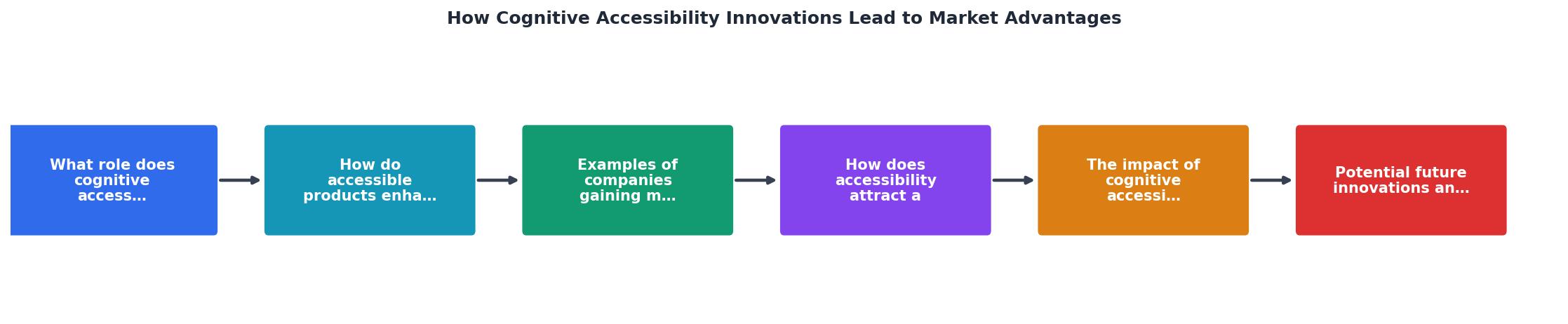
Tools like PagePerson Insights help bridge the gap between compliance auditing and cognitive accessibility analysis. Instead of only flagging WCAG technical violations, it surfaces comprehension barriers and cognitive friction points that traditional scanners miss. That kind of analysis turns accessibility data into actionable product improvements.
Future Innovations and Market Impact
Several emerging trends will amplify the market advantages of cognitive accessibility:
- AI-driven personalization that adapts content complexity, layout density, and interaction patterns to individual cognitive profiles in real time
- Multimodal interfaces combining voice, visual, and haptic feedback to support different cognitive processing styles
- Predictive cognitive load modeling that identifies high-friction points before users encounter them
- Regulatory expansion as the European Accessibility Act and similar legislation increasingly address cognitive criteria alongside sensory and motor requirements
Leveraging Cognitive Accessibility for Market Leadership
Your progress is saved automatically in your browser.
| Compliance-Only Approach | Market-Driven Accessibility |
|---|---|
| Fixes violations after audit | Designs for cognition from the start |
| Measures pass/fail against WCAG | Measures comprehension and task success |
| Budget allocated to remediation | Budget allocated to product improvement |
| Accessibility team works in isolation | Accessibility integrated into product and design |
| Reactive to legal risk | Proactive for market advantage |
| Covers sensory and motor criteria | Includes cognitive load and comprehension |
FAQ
Frequently Asked Questions
What cognitive accessibility improvement has had the biggest impact on your product's market performance? Share your experience in the comments.
Additional Resources
- How Accessibility Requirements Drive Product Innovation - Rather than compliance cost, accessibility becomes an R&D advantage that produces marketable features, competitive differentiation, and ...
- Why digital Accessibility Matters: Benefits for Users & ... - Businesses prioritizing accessibility create better user experiences, improve visibility, and reduce legal and reputational risks,
- Limiting Accessibility: How Targeting Consumers with ... - Specifically, consumers find charging price premiums for innovative products less acceptable when they are targeted at people with disabilities.