
Every year organizations spend millions defending accessibility lawsuits they could have prevented with a fraction of that budget. Cognitive accessibility standards are not just a compliance checkbox. They reduce support costs, expand market reach, and generate measurable revenue growth. This article breaks down exactly where the money goes and where it comes back.

- Adopting cognitive accessibility standards cuts support ticket volume, reduces legal exposure, and lowers remediation costs.
- Organizations that build accessibility into their workflows from the start see higher conversion rates and broader market reach.
- The economic case is not theoretical: reduced litigation costs alone can justify the investment, and the revenue upside from serving users with cognitive disabilities adds a significant growth channel.
The business case is already settled
Accessibility compliance used to be framed as charity or legal obligation. That framing is outdated. The World Health Organization estimates that over 1 billion people globally live with some form of disability, and cognitive disabilities represent the largest subset. That is not a niche market. It is a segment larger than the entire population of Europe.
When a website confuses visitors, those visitors leave. They do not file a complaint first. They just bounce. The cost of that bounce is invisible in most analytics dashboards because standard tools track where users leave, not why. Cognitive accessibility standards give organizations a framework to address the why: unclear navigation, dense language, inconsistent layouts, and missing error recovery paths.
The return on investment shows up in three places: lower support costs, reduced legal risk, and higher conversion from existing traffic. Each of these deserves a closer look.
How accessibility drives revenue growth

Revenue growth from accessibility is not speculative. It follows a straightforward chain:
- Broader audience reach. Cognitive accessibility improvements help users with ADHD, dyslexia, anxiety, low digital literacy, and age-related cognitive decline. That group overlaps heavily with mainstream users who simply find your site confusing.
- Lower abandonment rates. Clearer forms, simpler language, and predictable navigation reduce drop-off at every funnel stage.
- Improved SEO performance. Many cognitive accessibility practices (structured headings, descriptive link text, plain language) align directly with search engine ranking factors.
- Stronger brand trust. Organizations that visibly invest in inclusion build loyalty with all customers, not just those who need accommodations.
Companies like Microsoft, Apple, and Target have publicly documented how accessibility investments improved their overall user experience metrics. Target's landmark accessibility settlement in 2008 cost the company $6 million in legal fees alone. The subsequent accessibility overhaul improved usability for all customers and contributed to measurable e-commerce growth.
Cost savings from cognitive accessibility

The cost savings side of the equation is often more immediate than the revenue side. Here is where organizations see the fastest payback:
Support ticket reduction. When users can understand your interface without help, they stop calling. A government agency in the Netherlands reported a 30% reduction in support calls after redesigning forms using plain language and cognitive accessibility guidelines. Each support call costs between $5 and $50 depending on the channel and complexity. Multiply that by thousands of monthly contacts and the savings add up fast.
Remediation cost avoidance. Fixing accessibility issues after launch costs 10 to 100 times more than building them in from the start. This is the same principle as fixing bugs in production versus catching them in design. Organizations that adopt cognitive accessibility standards early avoid the expensive retrofit cycle.
Legal cost reduction. ADA-related digital accessibility lawsuits in the United States exceeded 4,000 filings per year in recent years. Average settlement costs range from $5,000 for small businesses to millions for large enterprises. Proactive compliance eliminates this entire cost category.
"The ADA Title II rule was expected to take effect for larger organizations April 24, 2026.">, Cognitive Accessibility (Digital) in 2026: Helping Users Stay Oriented, Focused,
This regulatory timeline means organizations that have not started their cognitive accessibility work are already behind. The cost of catching up under deadline pressure is always higher than planned, incremental adoption.
Where confusion costs real money

Cognitive barriers on websites create costs that most organizations never attribute correctly. A user who abandons a healthcare enrollment form because the language is too complex does not show up as an "accessibility failure" in any dashboard. They show up as a bounce. Or they call the support line. Or they give up entirely.
Consider these scenarios:
- Financial services: A bank's mortgage application uses jargon like "amortization schedule" and "escrow disbursement" without explanation. Users with lower financial literacy abandon the form. The bank pays for leads that never convert.
- Healthcare: A patient portal requires users to navigate three menus to find test results. Older adults and users with cognitive fatigue give up and call the clinic instead. Each call costs the clinic $15 to $25.
- E-commerce: A checkout flow presents 14 form fields on a single page with no progress indicator. Users with ADHD lose track of where they are and abandon their cart. The average cart abandonment rate is already around 70%. Cognitive barriers push it higher.
The implementation roadmap
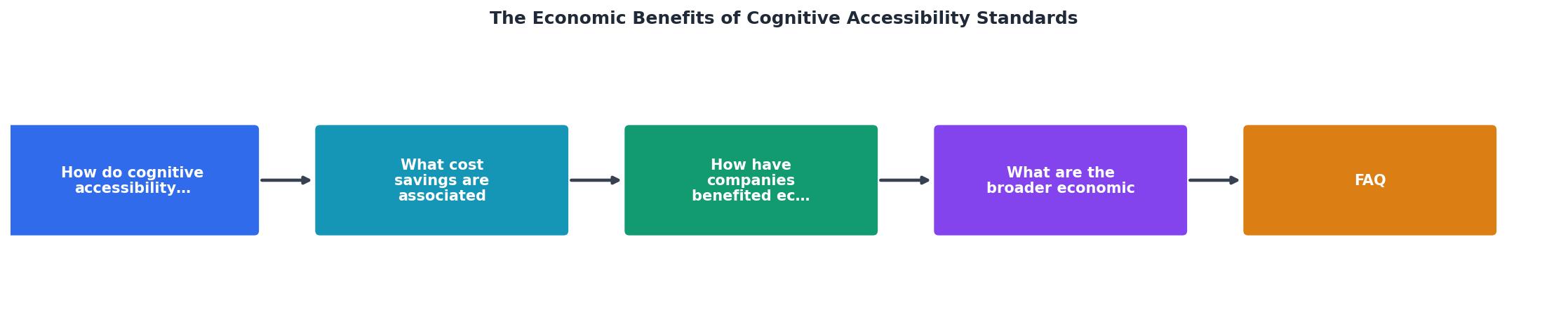
Implementing cognitive accessibility standards follows a predictable path. The diagram above shows the key steps: Audit, Prioritize, Implement, Test, Document, Monitor. Each step has a direct economic impact.
- Audit existing pages against WCAG cognitive accessibility success criteria and supplemental guidance. Identify the highest-traffic pages with the most barriers.
- Prioritize fixes by economic impact. A confusing checkout page on an e-commerce site costs more per day than a confusing "About Us" page.
- Implement changes starting with plain language, consistent navigation, clear error messages, and simplified forms.
- Test with real users who have cognitive disabilities. Automated tools catch structural issues; human testing catches comprehension failures.
- Document every change for compliance records. Regulators and auditors want evidence of process, not just outcomes.
- Monitor continuously. Accessibility is not a one-time project. New content and features introduce new barriers.
The organizations that see the best economic returns treat this as a continuous process, not a project with a finish line.
Industry-wide economic implications
The economic benefits extend beyond individual organizations. When entire industries adopt cognitive accessibility standards, the effects compound:
- Reduced public spending on support services. Government agencies spend less on assisted access programs when digital services work for everyone.
- Higher workforce participation. People with cognitive disabilities can use online job applications, training platforms, and workplace tools independently.
- Increased digital commerce. The accessible segment of the market grows, creating new revenue opportunities for every business in the ecosystem.
- Lower insurance and legal costs. Industries with strong accessibility track records face fewer class-action suits and lower compliance insurance premiums.
| Reactive Approach | Proactive Approach |
|---|---|
| Fix after lawsuits | Build accessible from start |
| $50K-$500K+ per settlement | $5K-$50K upfront investment |
| Repeated remediation cycles | One-time integration into workflow |
| Brand damage from public suits | Brand equity from inclusion leadership |
| Support costs stay high | Support costs decrease over time |
The following dashboard illustrates a typical mid-size organization's economic profile before and after adopting cognitive accessibility standards:
Economic Impact Dashboard
Economic Impact Assessment Template
Your progress is saved automatically in your browser.
FAQ
Frequently Asked Questions
Additional Resources
- Cognitive Accessibility (Digital) in 2026: Helping Users Stay ... - Cognitive accessibility plays an essential role in ensuring people with cognitive disabilities can equitably access digital government services.
- Why Digital Accessibility Benefits Everyone - It reduces barriers that prevent individuals from fully participating in society, ensuring fair access to vital services for all. By addressing ...
- Barriers to creating value with cognitive accessibility features ... - The benefits of cognitive accessibility, e.g., better customer experience or better usability in digital services, have been studied from the ...