
Most brands spend thousands on logos, color palettes, and ad campaigns to shape how customers perceive them. Almost none of them invest in making their website understandable to the 42% of visitors who struggle with cognitive barriers like information overload, unclear navigation, or confusing copy. The irony is brutal: the single cheapest way to look like a premium, trustworthy brand is to make your site easy to think through. This article breaks down exactly how cognitive accessibility lifts brand perception, drives loyalty, and gives you a competitive edge that competitors cannot fake.

- Cognitive accessibility directly shapes how visitors judge your brand within seconds of landing on your site.
- Brands like Apple, Microsoft, and Nike treat accessibility as a brand differentiator, not a compliance checkbox, and their customer retention numbers reflect it.
- Integrating cognitive accessibility into your branding strategy increases trust, reduces bounce rates, and turns one-time visitors into loyal customers.
Brand perception starts with comprehension
A visitor who cannot parse your headline in three seconds does not think "this site has a cognitive accessibility problem." They think "this brand is confusing" or "this company doesn't care about me." That gut reaction sticks. It colors every future interaction with your product, your emails, your ads.
Cognitive accessibility refers to how easily a person can perceive, understand, and act on the information presented to them. It goes beyond screen readers and color contrast. It covers reading level, information hierarchy, decision fatigue, and whether someone with ADHD, dyslexia, anxiety, or simply low familiarity with your product category can figure out what you sell and why it matters.
That number is not hypothetical. It accounts for people with situational impairments (tired, distracted, on mobile in bright sunlight), permanent cognitive differences, and the large chunk of your audience that simply does not share your team's insider knowledge of the product.
When comprehension fails, brand perception tanks. When comprehension succeeds, visitors attribute that ease to your brand being "professional," "trustworthy," and "well-designed." They rarely know why they feel that way. They just do.
How accessibility shapes brand identity

Brand identity is the sum of every interaction a person has with your company. Your website is often the first and most frequent touchpoint. If that touchpoint creates friction, the friction becomes part of your brand.
Here is what happens when cognitive accessibility is neglected:
- Visitors bounce faster. Pages with dense, jargon-heavy copy lose visitors within 10 seconds. Those visitors associate your brand with confusion.
- Trust erodes. Unclear pricing pages, ambiguous CTAs, and walls of text signal that a company is either hiding something or does not respect the visitor's time.
- Word-of-mouth suffers. People recommend brands they find easy to use. Nobody says "you should check out this site, it took me 15 minutes to figure out what they sell."
- Paid acquisition ROI drops. You pay the same cost-per-click whether the visitor understands your page or not. Cognitive barriers turn ad spend into waste.
The connection between website usability and brand credibility is well-documented. Visitors form design-based trust judgments in as little as 50 milliseconds. Cognitive accessibility determines whether that snap judgment lands on "trustworthy" or "sketchy."
Brands that leverage accessibility
Several major brands treat accessibility as a core brand value, not an afterthought bolted on by the legal team.
Apple built its entire brand around simplicity. The cognitive load on apple.com is remarkably low: short sentences, massive whitespace, one clear action per screen. This is not accidental. Apple's design philosophy treats reduced cognitive friction as a premium feature. The result is a brand that people describe as "intuitive" and "elegant," words that directly map to low cognitive load.
Microsoft invested heavily in its Inclusive Design methodology starting in 2015. The company publishes its inclusive design toolkit openly and applies it across products from Windows to Xbox. The Xbox Adaptive Controller became a brand perception milestone: it showed that Microsoft cared about users other companies ignored. Sales of the controller itself were modest, but the brand lift was enormous.
Nike launched FlyEase, a line of shoes designed for people with disabilities. The product line generated significant media coverage and shifted perception of Nike from "athletic performance brand" to "brand that includes everyone." FlyEase shoes now sell to a broad audience, including parents who want easy-on shoes for kids.
Gov.uk redesigned the entire UK government web presence around plain language and clear task flows. The result was a site that consistently ranks among the most trusted government websites globally. The design system they created became a reference standard for cognitive accessibility in public-sector digital services.
These brands share a pattern: they treated accessibility as a design constraint that produced better outcomes for everyone, not as a compliance burden.
"Brent Stewart, a senior director analyst with the research firm Gartner stated that "By 2023, digital products in full WCAG Level 2 compliance will outperform their market competitors by 50%.".">, How to Enhance Your Brand Through Accessibility
Accessibility builds customer loyalty

Loyalty is not about rewards programs. It is about repeated positive experiences that build trust over time. Cognitive accessibility contributes to loyalty through three mechanisms:
Reduced effort builds preference. The psychological principle of cognitive fluency shows that people prefer things that are easy to process. A website that is easy to read, easy to navigate, and easy to act on creates a positive emotional association. That association compounds with every visit.
Inclusion creates emotional connection. When a person with dyslexia, ADHD, or anxiety can use your site without struggling, they notice. They may not articulate it as "this site has good cognitive accessibility," but they feel seen and respected. That feeling drives loyalty far more than a 10% discount code.
Consistency signals reliability. Brands that maintain clear, accessible communication across their website, emails, and product UI signal that they are organized and dependable. Inconsistent experiences (clear landing page, confusing dashboard, jargon-filled help docs) erode trust.
The math is straightforward. Acquiring a new customer costs 5 to 7 times more than retaining an existing one. Every cognitive barrier on your site is a small push toward churn. Remove those barriers, and you reduce churn without spending a dollar on retention campaigns.
Here is a practical example: an e-commerce brand with a confusing returns policy page will generate support tickets, negative reviews, and lost repeat purchases. Rewriting that page at a 7th-grade reading level with clear steps and visual cues costs almost nothing. The impact on customer satisfaction and repeat purchase rate is measurable within weeks.
Strategies for accessible branding

Integrating cognitive accessibility into your brand is not a one-time project. It is a set of practices that become part of how your team creates and reviews content. The following process covers the essential steps.
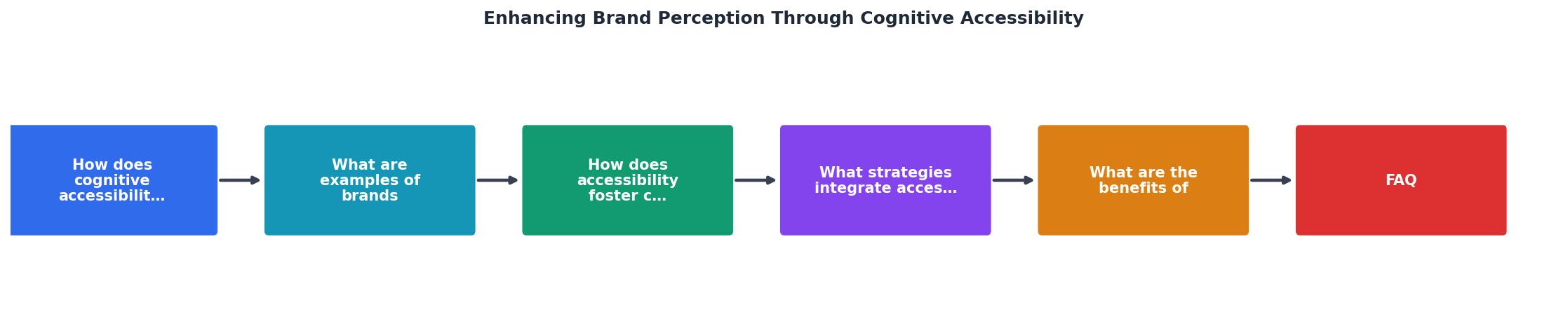
The diagram above outlines the core loop: Audit, Simplify, Test, Measure, Iterate. Each step feeds the next.
Audit your current cognitive load. Start by identifying where visitors struggle. Tools like PagePerson Insights can scan your pages and surface specific cognitive barriers: reading level issues, unclear CTAs, information overload, and navigation confusion. This gives you a baseline and a prioritized list of fixes.
Simplify copy and structure. Rewrite headlines to state the benefit in plain language. Break long paragraphs into scannable chunks. Replace jargon with common words. Use one CTA per section. These changes cost nothing but time and have an outsized impact on comprehension.
Test with diverse users. Recruit testers who represent the cognitive diversity of your actual audience. Include people who are unfamiliar with your product category, people with ADHD or dyslexia, and people over 60. Their feedback will reveal barriers your team cannot see because of the curse of knowledge.
Measure the impact. Track conversion rate, time-on-page, bounce rate, and support ticket volume before and after accessibility improvements. These metrics connect cognitive accessibility directly to business outcomes, which makes it easier to justify continued investment.
Iterate continuously. Every new page, feature, or campaign is an opportunity to introduce cognitive barriers. Build accessibility checks into your content review process so clarity stays consistent as your site grows.
The following interactive card summarizes the brand perception shift that cognitive accessibility improvements typically produce across key dimensions:
Brand Perception Shift
These numbers represent a typical pattern observed across e-commerce and SaaS sites that undertake focused cognitive accessibility work. Your specific results will vary, but the direction is consistent: clarity improves every metric that matters.
Benefits beyond conversion
The business case for cognitive accessibility extends well past conversion rate optimization. Here are the benefits that compound over time:
- SEO improvement. Search engines reward clear, well-structured content. Pages with logical heading hierarchies, plain language, and good readability scores tend to rank higher. Google's helpful content guidelines explicitly favor content written for humans over content stuffed with keywords. For a deeper look at this connection, see our piece on cognitive accessibility SEO strategies.
- Reduced legal risk. Accessibility lawsuits have increased year over year. While most target visual and motor accessibility, cognitive accessibility is gaining attention in regulatory frameworks like the European Accessibility Act. Proactive investment now reduces exposure later.
- Lower support costs. Every confusing page generates support tickets. Clear copy and intuitive flows reduce the volume of "how do I..." and "what does this mean..." inquiries.
- Broader market reach. Cognitive accessibility improvements help everyone, not just people with diagnosed conditions. A clearer site converts better across all demographics, age groups, and literacy levels.
- Employee brand alignment. Teams that practice inclusive design tend to produce better work across the board. The discipline of writing clearly and designing for comprehension raises the quality bar for everything the company ships.
If you want to quantify the return on your own accessibility investment, our guide on measuring ROI of cognitive accessibility walks through the specific metrics and calculation methods.
Cognitive Accessibility Brand Integration Checklist
Your progress is saved automatically in your browser.
FAQ
Frequently Asked Questions
Additional Resources
- How to Enhance Your Brand Through Accessibility - Build Brand through Empathy and Accessibility Companies that don't prioritize accessibility as part of their development and testing strategies will get left ...
- The role of octomodal mental imagery and social presence - This study investigated the impact of Octomodal Mental Imagery (OMI) on brand experience and authenticity in advocating sustainable development.
- How Accessibility affects Usability and Brand Perception - The accessibility and usability of any site is pivotal to a user's experience of it. Both aim to define and deliver a more intuitive user experience.