Jasper person: Practical Guide
Most websites are built for the people who made them, not the people who use them. A Jasper person is a cognitive accessibility persona that represents visitors who face real comprehension barriers on your site, from cancer survivors dealing with chemo brain to anyone overwhelmed by dense layouts and unclear copy. This guide walks you through building and applying a Jasper person to your product so you stop guessing why visitors bounce and start fixing the actual friction points.

Most websites are built for the people who made them, not the people who use them. A Jasper person is a cognitive accessibility persona that represents visitors who face real comprehension barriers on your site, from cancer survivors dealing with chemo brain to anyone overwhelmed by dense layouts and unclear copy. This guide walks you through building and applying a Jasper person to your product so you stop guessing why visitors bounce and start fixing the actual friction points.

- A Jasper person is a user persona focused on cognitive accessibility, representing visitors who struggle with information overload, unclear language, or reduced processing capacity.
- Building one takes a few hours and immediately reveals conversion-killing friction you cannot see in analytics dashboards.
- This guide gives you a step-by-step process, common mistakes to avoid, and a ready-to-use checklist.
What a Jasper person actually is
The term comes from supportive care and accessibility communities. A Jasper person represents a real category of user: someone navigating your website while dealing with cognitive load challenges. That includes people recovering from medical treatment, visitors with ADHD or dyslexia, older adults unfamiliar with modern UI patterns, or simply someone multitasking on a phone during a commute.
"Preview our most popular resources for people who have completed treatment, reviewed by Jasper's expert cancer supportive care guides.">, 1
Traditional personas focus on demographics and goals. A Jasper person adds a cognitive layer: how does this visitor process information, and where does your site break down for them? That distinction changes everything about how you evaluate your pages.
That number is not hypothetical. Cognitive barriers affect a far larger slice of your audience than most founders realize. People with temporary cognitive impairment (stress, fatigue, medication side effects) outnumber those with permanent conditions by a wide margin.
Why this matters for conversion

You spent money getting visitors to your landing page. Google Ads, content marketing, referral partnerships. Then 60-80% of them leave without converting. Analytics tells you where they drop off. Heatmaps show what they click. Neither tells you why they got confused.
A Jasper person forces you to walk through your site as someone with reduced cognitive bandwidth. Suddenly you notice:
- Jargon-heavy headlines that assume domain knowledge
- Walls of text with no visual hierarchy
- Ambiguous CTAs like "Get Started" that do not explain what happens next
- Multi-step forms that demand too much working memory
- Inconsistent navigation that breaks mental models
Fixing these problems does not require a redesign. It requires seeing your site through a different lens. That is exactly what a Jasper person provides.
Common mistakes when building personas

Before the step-by-step, here are the traps I see teams fall into repeatedly:
- Making it fictional. A Jasper person is not a creative writing exercise. Base it on real support tickets, session recordings, and user feedback. If you invent the struggles, you will fix the wrong things.
- Treating it as a one-time artifact. Personas rot. Your site changes, your audience shifts. Review your Jasper person quarterly.
- Focusing only on permanent disabilities. Temporary and situational impairments (broken arm, noisy environment, sleep deprivation) affect far more visitors. Include them.
- Skipping the walkthrough. Building the persona document is step one. The value comes from actually navigating your site as that person, screen by screen.
- Ignoring mobile context. Cognitive load doubles on a small screen with spotty connectivity. Your Jasper person should have a mobile scenario.
Step-by-step: build your Jasper person
Here is the process that works. Each step takes 30-60 minutes. You can complete the full cycle in a single afternoon.
Step 1: Gather cognitive friction data
Pull data from three sources:
- Support tickets and chat logs. Search for phrases like "I don't understand", "where do I find", "this is confusing", "I gave up."
- Session recordings. Watch 20-30 sessions where users abandoned a key flow. Note hesitation, back-and-forth navigation, and rage clicks.
- Bounce analytics. Identify pages with high bounce rates and low scroll depth. These are your cognitive friction hotspots.
Step 2: Identify constraint patterns
Group the friction you found into categories:
- Language barriers (jargon, long sentences, ambiguous terms)
- Visual overload (dense layouts, competing elements, no whitespace)
- Memory demands (multi-step processes, information split across pages)
- Decision fatigue (too many options, unclear differences between choices)
Step 3: Write the persona document
Keep it to one page. Include:
- A name and a brief scenario (not a biography)
- 3-5 specific cognitive constraints (e.g., "reads at a 6th-grade level", "gets distracted every 90 seconds", "cannot hold more than 3 options in working memory")
- The primary task they are trying to complete on your site
- What success looks like for them
Step 4: Walk your site as the Jasper person
Open your homepage. Read every word as someone with the constraints you defined. Ask at each screen:
- Can I understand what this page wants me to do within 5 seconds?
- Do I know what happens when I click this button?
- Am I being asked to remember something from a previous page?
- Is there a simpler path to my goal?
Step 5: Prioritize and fix
Rank friction points by two criteria: how many visitors hit this and how close to conversion it sits. Fix the high-traffic, near-conversion issues first. A confusing pricing page matters more than a confusing blog sidebar.
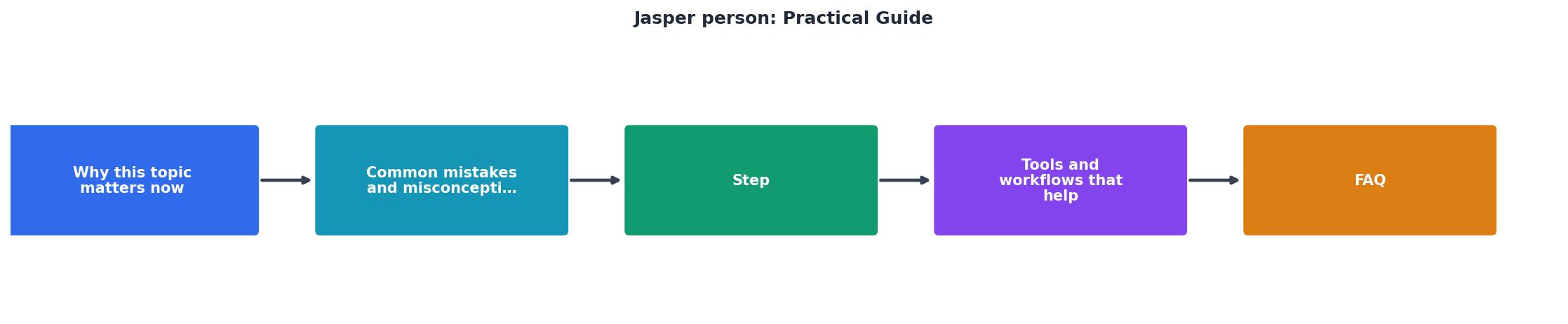
The following interactive card summarizes the five-step process and typical time investment:
Build Your Jasper Person: 5 Steps
Tools and workflows that help

You do not need expensive software to build a Jasper person. Here is what works:
- Hemingway Editor for checking reading level. Paste your page copy and aim for grade 6-8.
- Hotjar or FullStory for session recordings that reveal cognitive friction in real time.
- Google Sheets for tracking friction points, categorizing them, and assigning priority scores.
- PagePerson Insights can scan your pages for cognitive accessibility barriers automatically, flagging the exact issues a Jasper person would encounter. It saves hours of manual walkthrough time.
- Figma annotations for marking friction points directly on design files so developers see them in context.
| Manual Walkthrough | Tool-Assisted Audit |
|---|---|
| 4+ hours per key flow | Under 30 minutes |
| Subjective findings | Data-backed friction scores |
| Hard to repeat consistently | Repeatable across pages |
| Requires trained reviewer | Accessible to any team member |
Keeping your Jasper person alive
A persona that lives in a Google Doc nobody opens is worthless. Integrate it into your workflow:
- Add a "Jasper person check" to your PR review template for any page or copy change.
- Include one Jasper-person scenario in every usability test session.
- Share friction findings in a monthly Slack digest so the whole team stays aware.
- Update the persona constraints every quarter based on fresh support data.
Jasper Person Implementation Checklist
Your progress is saved automatically in your browser.
FAQ
Frequently Asked Questions
What cognitive friction have you spotted on your own site that analytics never explained? Share your experience below.
Additional Resources
- Jasper - Self-Help: Books - How to Make Friends as an Adult: A Practical Guide to Overcome Loneliness, Build Adult Friendships, and Create the Social Life You Want · by Jasper Cantrell.
- 1-on-1 Cancer Support for People No Longer in Treatment - Jasper guides you through the whole journey. · Adjusting to physical changes · Monitoring and managing pain and discomfort · Coping with the fear of the unknown.
- The Good PA Guide - Understanding the role of personal ... - Good PA Guide: understanding the role of personal assistance to people with disabilities. A practical guide addressing key learning around historical evolution.
Need Help with Accessibility?
Improve your site's accessibility and conversion rates with our AI-powered analysis.
Get Started